My post this week was originally going to be about menstrual products - pads, tampons, etc - and their pros and cons and use, but that's going to get pushed back a week because I received a comment on the hymen post that really made my blood boil. Someone who I really really hope was a spambot left a link to a website selling a "virginity restoration kit," claiming to repair the hymen and restore a woman's virginity so that her "shameful little secret" wouldn't come to light on her wedding night (I've since deleted the comment).
There is so much wrong with this product that I hardly know where to begin.
First of all, I'm picturing something like a bicycle tire repair kit - superglue and patches of vinyl... Which is ridiculous because, as we discussed, the hymen isn't a wall of tissue. It's a stretchy corona of mucus tissue. The hymen doesn't pop like a punctured tire, letting all that precious virginity leak out. It gets slowly eroded away through hormone exposure and the movement of daily life, like a cliff on the sea getting worn away by waves. Inexorable, gradual, and irreversible.
There are definitely surgeons out there who are willing to do a "hymen repair surgery," which involves stitching worn sections of the hymen back together. The thing is, most of these surgeons will readily admit that the stitches fall out, often before the patient even gets to the parking lot because it's "like stitching through butter." Most women who choose to have such a procedure do so because of religious or societal pressure to prove virginity by bleeding on the wedding night, something that only occurs in less than half of women during their first penetrative sex anyway.
Second of all, the hymen has absolutely nothing to do with virginity. There is no way to look at woman's hymen and tell whether or not she has had penetrative sex, because again, THE HYMEN DOESN'T POP OR TEAR. It's not like the safety seal on jar, with the little button that pops up to let you know it's been opened before.
And that's of course assuming an extremely heteronormative view of virginity - that is, one which regards male-and-female penis-in-vagina (PIV) sex as the only type of "real" sex. What about oral sex? Anal sex? Gay and lesbian sex? Is a lesbian woman who has only ever engaged in sexual acts with women considered a virgin her entire life? According to the definitions of this "virginity restoration kit", you could have anal sex with a hundred different partners, and engage is lesbian sex morning til night, and you'd still be a virgin.
Does that sound logical to you? Maybe it does. I went to a Catholic high school, where peers drew very very fine distinctions between what was and what was not sex. When we discussed anal sex in health class, some people said it was okay because "you're still a virgin." Same with oral. Isn't that the distinction that President Clinton made? Oral doesn't count? Well then what does count? How can you define virginity so narrowly when the definition of sex can vary from person to person?
And what about non-consensual sex? If a girl's first experience with genital sex is rape, should she be shamed about not "being a virgin" any more? Goddamn, that is some victim-blaming nonsense right there.
Thirdly, where is the male virginity restoration kit? Shouldn't he be a virgin on the wedding night, too? We hear all this preaching about female virginity and "popping the cherry" (an incredibly misleading euphemism in itself) but where's the male equivalent? Maybe we should come up with one right now, one that carries the same connotations of something irrevocably lost or broken. Leave 'em in the comments.
And finally, all of this assumes that having premarital PIV sex is something horrible and shameful, enough that you should drop $29.99 + shipping and handling to shove some make believe up your hooha to keep your new hubby and his family from freaking out. I have three words for you:
Sex.
Is.
Awesome.
Sex can be fun and hot and random, and it can be sweet and tender and beautiful, it can be rough or silly or awkward or mind-blowing or mediocre. It can be with a guy or a girl, or with multiple people. It can be with someone you just met or someone you've known for years. Sex can be vaginal or anal or oral or with fingers or toes or toys. It can be kinky or vanilla. It can cause bone-shaking orgasm or just be kind of "meh." But there is one thing sex definitely is not, and that's shameful.
Virginity isn't physical, and it's nothing that can be proven by looking at party parts. Virginity is a state of mind.
Girls ask things like, "If I use a tampon, am I still a virgin?" Well... have you engaged in any physical activity that you regard as sex? If not, then you're a virgin, regardless of what cotton contraption you use to stem the crimson tide.
They ask, "My boyfriend went down on me, am I still a virgin?" Well, do you consider oral sex to be virginity-losing sex? It's all up to you. If you decide that having oral sex means you're still a virgin, then guess what? You are. Because everyone's definition of "real sex" is different, everyone's definition of virginity is different. Rather than saying you're a virgin or not, be honest with yourself and your partners about your sexual history. Instead of, "I'm a virgin," say "I've never engaged in PIV sex" or "I've received oral sex but never given it" or whatever list of activities you have or haven't tried.
They ask, "My first time was disappointing, or I was raped, can I be a virgin again and have a do-over?" You can have as many do-overs as you like. People make a huge deal about a girl losing her virginity, but all it means is that you've had a physical experience you've never had before. No one talks about "losing your push-up virginity" the first time you do a push-up, or "popping your car cherry" the first time you drive a car. Nothing is lost or broken or destroyed, it's just different.
Ugh. My fingers are getting tired. I'd like to talk about the whole societal and historical context for virginity, but that's going to have to wait for another day. Perhaps a mid- or early-week post. Goddamn spam bots, getting me all riled up. I need a cocktail and some knitting, and it's not even one in the afternoon here. For more on defining virginity, check out this awesome Scarleteen article, "Three on Virginity."
Showing posts with label friday post. Show all posts
Showing posts with label friday post. Show all posts
Friday, June 14, 2013

Friday, May 3, 2013
Anatomy: Internal reproductive system
Now that we've covered all the details of external genital anatomy, it's time to move on to the inner plumbing. The internal reproductive system consists of five main parts:

The Vagina
Now we're talking about the literal vagina, NOT the common slang meaning of vagina, which usually refers to the vulva. The vagina is basically a tube that connects the external vulva to the uterus. In its relaxed state, the vagina is usually a few inches deep, but lengthens during arousal. It also produces its own handy-dandy lubricants and stretches or contracts to accommodate an inserted penis or other object. It functions as the birth canal, as well, as its extremely elastic nature allows it to stretch to many times its normal diameter. The vagina also provides a path for menstrual fluid to leave the body.
The Cervix
If the vagina is like a drawbridge connecting the uterus to the vulva, then the cervix would be the porticullis - it's a seal or valve between the vagina and the uterus. Most of the time, it's tightly closed, stretching open only during menstruation - which may the cause of some women's cramps, or at least part of it. During childbirth, the cervix dilates to 10 cm wide, allowing enough space for spawning.
The cervix has two main parts - the side that faces the vagina, and the side that faces the uterus. These are called the ectocervix and the endocervix, respectively. The ectocervix (vagina side) is slight rounded and projects about 3 cm into the vaginal canal on average. The opening in the ectocervix is called the external os. The endocervix (uterus side) is more canal-shaped, as it's basically the inside of the ectocervix, so it's sometimes referred to as the endocervical canal. The opening in the endocervix is called the interal os.
The Uterus
The uterus is the major organ of female reproduction. It's roughly pear-shaped and made up of muscle tissue, allowing it to contract during childbirth and menstruation. The uterus is lined with tissue called the endometrium, which grows thick and full of blood vessels during the menstrual cycle. At the end of the cycle, if you're not pregnant, the endometrial lining will shed, exiting the body through the vagina with the help of small uterine contractions... so this is the bastard that's responsible for your periods. During pregnancy, the endometrium becomes even thicker and more solid, forming the placenta that provides oxygen and nutrition to the develping embryo. The uterus itself acts as physical protection for a developing embryo and, during the birth process, contracts to push the baby out.
Fallopian Tubes
The Fallopian tubes, also called the oviducts, are two tubes that lead from the uterus to the ovaries. These tubes are lined with tiny cilia (wavy hair-like structures) that help the ova travel from the ovaries to the uterus during ovulation.

Fertilization (sperm meets egg) usually occurs in the fallopian tube, with the fertilized egg continuing its journey to implant in the uterus, beginning pregnancy.
The Ovaries
The ovaries are a small pair of organs at the end of each Fallopian tube, and are responsible for the production of ova or eggs (singular = ovum). The ovaries are also a source of estrogen and progesterone, two extremely important hormones related to puberty, menstruation, and pregnancy.
Since we're talking about hormones, I think next week's post will go into more detail about them, specifically how and why they cause puberty. The week after that we'll go into the menstrual cycle, everyone's favorite monthly kick-in-the-crotch.
Aww, it's so pretty. Like some sort of pink squid.
The Vagina
Now we're talking about the literal vagina, NOT the common slang meaning of vagina, which usually refers to the vulva. The vagina is basically a tube that connects the external vulva to the uterus. In its relaxed state, the vagina is usually a few inches deep, but lengthens during arousal. It also produces its own handy-dandy lubricants and stretches or contracts to accommodate an inserted penis or other object. It functions as the birth canal, as well, as its extremely elastic nature allows it to stretch to many times its normal diameter. The vagina also provides a path for menstrual fluid to leave the body.
The Cervix
If the vagina is like a drawbridge connecting the uterus to the vulva, then the cervix would be the porticullis - it's a seal or valve between the vagina and the uterus. Most of the time, it's tightly closed, stretching open only during menstruation - which may the cause of some women's cramps, or at least part of it. During childbirth, the cervix dilates to 10 cm wide, allowing enough space for spawning.
The cervix has two main parts - the side that faces the vagina, and the side that faces the uterus. These are called the ectocervix and the endocervix, respectively. The ectocervix (vagina side) is slight rounded and projects about 3 cm into the vaginal canal on average. The opening in the ectocervix is called the external os. The endocervix (uterus side) is more canal-shaped, as it's basically the inside of the ectocervix, so it's sometimes referred to as the endocervical canal. The opening in the endocervix is called the interal os.
The Uterus
The uterus is the major organ of female reproduction. It's roughly pear-shaped and made up of muscle tissue, allowing it to contract during childbirth and menstruation. The uterus is lined with tissue called the endometrium, which grows thick and full of blood vessels during the menstrual cycle. At the end of the cycle, if you're not pregnant, the endometrial lining will shed, exiting the body through the vagina with the help of small uterine contractions... so this is the bastard that's responsible for your periods. During pregnancy, the endometrium becomes even thicker and more solid, forming the placenta that provides oxygen and nutrition to the develping embryo. The uterus itself acts as physical protection for a developing embryo and, during the birth process, contracts to push the baby out.
Fallopian Tubes
The Fallopian tubes, also called the oviducts, are two tubes that lead from the uterus to the ovaries. These tubes are lined with tiny cilia (wavy hair-like structures) that help the ova travel from the ovaries to the uterus during ovulation.
Above: Eleven doing an interpretive dance of cilia.
Fertilization (sperm meets egg) usually occurs in the fallopian tube, with the fertilized egg continuing its journey to implant in the uterus, beginning pregnancy.
The Ovaries
The ovaries are a small pair of organs at the end of each Fallopian tube, and are responsible for the production of ova or eggs (singular = ovum). The ovaries are also a source of estrogen and progesterone, two extremely important hormones related to puberty, menstruation, and pregnancy.
Since we're talking about hormones, I think next week's post will go into more detail about them, specifically how and why they cause puberty. The week after that we'll go into the menstrual cycle, everyone's favorite monthly kick-in-the-crotch.
Friday, April 26, 2013
Anatomy: The Clitoris
Today's anatomy lesson is going to focus on the clitoris, or clit, the main sensory organ of female sexual arousal. As we discussed in the vulva anatomy post, the visible portion of the clit is located near the junction of the labia minora and is generally the size and shape of a greenpea or a bit smaller than a pencil eraser. This visible bit, called the glans, is wholly or partially covered by the clitoral hood or prepuce. Again, I encourage you to break out your little mirror and find your clitoris and clitoral hood.
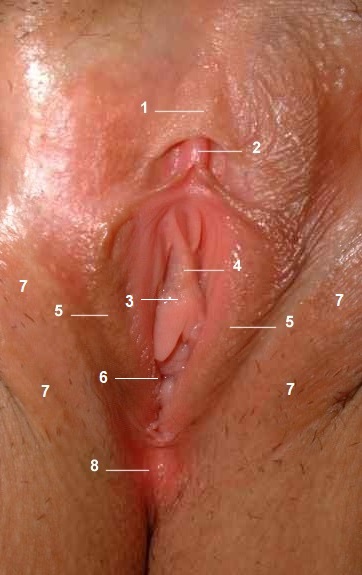


A hand roadmap to the clitoris. 1. Clitoral hood (prepuce); 2. Clitoral glans; 3. Urethral opening;
4. Vulval vestibule; 5. Labia minora; 6. Vaginal opening; 7. Labia majora (hair removed); 8. Perineum
But the clitoris doesn't stop there (contrary to what all my anatomy textbooks said!). While the glans is certainly the most readily apparent part of the clit, it has additional structures that extend through the labia majora and around the vagina opening.The clitoris is a complex structure, with both internal AND external components, and its size and sensitivity can vary greatly from person to person. The clit as a whole is estimated to have more than 8,000 nerve endings, more than any other place in the human body (even the head of the male penis).
The internal structures of the clitoris. Note that the clitoral hood and labia minora
and majora are left transparent in this illustration.
The internal portion of the clitoris forms a wishbone or wing-like structure that contains the corpus cavernosum - spongey erectile tissue similar to that in the shaft of the male penis. When aroused, these fill with blood and cause clitoral erection. That's right, we get ladyboners.
This totally would be his sex face.
The corpus cavernosum extends several centimeters before branching into a pair of crura (legs) called the crus clitoris. These crura are concealed behind the labia minora and follow along behind it to meet at the fourchette (the lowest point of the vulva where the labia fade into the perineum or "taint").
Related to the clitoris, but actually a separate structure, are the vestibular bulbs, which are made up of the same erectile tissue. These bulbs lie close to the crura on either side of the vaginal opening, beneath the labia majora. When aroused, these bulbs fill with blood and cause the vulva to swell outward.
All right. Now that we know what it IS, let's talk about what it DOES.
The clit apparently exists for one reason: female orgasm. Unlike the male penis, which is required for reproduction and urination, the clit serves no direct reproductive purpose (as female orgasm isn't required for conception) and no bodily function. It's a pleasure center.
Just like Robert Downey Jr, it exists just to make you happy.
The majority of women (70-80%) achieve orgasm only through direct clitoral stimulation - that is, fingers or mouth stimulating the clitoral glans, hood, or shaft. Because the glans itself is so packed with nerve endings, direct contact with it can be uncomfortable or even painful, so many women prefer indirect stimulation of the glans through the hood or labia.
For a long time, famous psychologist and all-around jerk Sigmund Freud postulated that there were 2 types of female orgasm - the clitoral and the vaginal. He said that the clitoral orgasm was immature and adolescent and that sexually mature women would be able to orgasm through vaginal penetration alone. His ideas persisted until Alfred Kinsey challenged them during his studies of human sexuality in the 30s, 40s, and 50s. Kinsey observed female masturbation techniques and found that the vast majority could not orgasm vaginally, and that very few even bothered to insert fingers or objects into their vaginas while masturbating; they focused instead on the clitoris. He eventually concluded that vaginal orgasms were nearly physiologically impossible because the vagina has so few nerve endings compared to the clitoris.
Later, Masters and Johnson built off Kinsey's research and discovered those crus clitoris which extend behind and within the labia. They discovered that vaginal orgasms and clitoral orgasms share the exact same stages of physical response, and reasoned that the so-called vaginal orgasm was the result of indirect clitoral stimulation, such as the clitoral hood rubbing the clitoris during penetrative sex and stimulation of the internal portions of the clitoris.
A demonstration. This is totally his sex face, too.
That seems like a good image to leave you with for this week... Next week, we move on to internal reproductive anatomy.
Friday, April 19, 2013
Anatomy: The Hymen
First things first: please accept my profuse apologies for this post being a full week late. My husband and I were out of town last week looking at houses, as we're moving between states pretty soon, and it's been kind of a busy time. The next few weeks may see posts being early or late as we prepare to move.
Dear Readers, I am ludicrously excited to do this post. It's the reason I started this blog to begin with, and the whole hymen issue is something that gets my hackles up. We'll go into the social pressures around female virginity at some point, and the whole "purity" debacle, and what the "first time" is actually like, but I feel that this is one issue where the anatomical facts and the social expectations are of equal importance. So the hymen gets its own post. Yay!
I've taken classes in human sexuality 3 times in my life: an ongoing "Family Life" course over 5-7th grade, a religious studies elective in my senior year of high school, and a humanities elective during my second year of college. NONE OF THEM DISCUSSED THE REALITIES OF THE HYMEN. The college course touched a bit on the atypical hymens, but not one talked about what it really is.
If you're like me, you've grown up hearing phrases like "popping the cherry" as euphemisms for a girl losing her virginity. You've heard of things like a "torn hymen" and bleeding during sex as proof that it was her first time. You've seen shows like True Blood, where poor vampire Jessica can't have sex without pain because her crazy vamp healing abilities make her hymen grow back. You've seen things like Law and Order SVU where they say an intact hymen is proof that rape hasn't occurred. You've read Game of Thrones and similar stories where a girl's virginity is called into question, so she's examined by doctors or religious elders or midwives to determine if her hymen is still in place. Perhaps you grew up with a religious background that emphasizes female purity, and have been told that things like tampons can break the hymen.
You probably picture the hymen as something like this:




Dear Readers, I am ludicrously excited to do this post. It's the reason I started this blog to begin with, and the whole hymen issue is something that gets my hackles up. We'll go into the social pressures around female virginity at some point, and the whole "purity" debacle, and what the "first time" is actually like, but I feel that this is one issue where the anatomical facts and the social expectations are of equal importance. So the hymen gets its own post. Yay!
I've taken classes in human sexuality 3 times in my life: an ongoing "Family Life" course over 5-7th grade, a religious studies elective in my senior year of high school, and a humanities elective during my second year of college. NONE OF THEM DISCUSSED THE REALITIES OF THE HYMEN. The college course touched a bit on the atypical hymens, but not one talked about what it really is.
If you're like me, you've grown up hearing phrases like "popping the cherry" as euphemisms for a girl losing her virginity. You've heard of things like a "torn hymen" and bleeding during sex as proof that it was her first time. You've seen shows like True Blood, where poor vampire Jessica can't have sex without pain because her crazy vamp healing abilities make her hymen grow back. You've seen things like Law and Order SVU where they say an intact hymen is proof that rape hasn't occurred. You've read Game of Thrones and similar stories where a girl's virginity is called into question, so she's examined by doctors or religious elders or midwives to determine if her hymen is still in place. Perhaps you grew up with a religious background that emphasizes female purity, and have been told that things like tampons can break the hymen.
You probably picture the hymen as something like this:
Ahh Cassandra, yours is the first episode of DW I ever saw.
Or, to use words, you picture it as a thin veil of tissue stretched across your vagina, a barrier or membrane that is torn or popped or broken when you have sex (or use a tampon, if my religious upbringing is to be believed).
And there is a type of hymen (called an imperforate hymen) in which this is the case.
But for most of us, the hymen is just a thin corona of mucusy tissue located an inch or so inside the vaginal opening. It's stretchy, and delicate, and actually wears away over time due to estrogen exposure and physical activity.
Your hymen is a unique snowflake. A beautiful, mucus-y snowflake.
Remember a few weeks ago I asked you to take out a mirror and identify the structures in the vulva anatomy post? Let's do that again. Take a look at your vaginal opening (a flashlight may be helpful here) and see if you can identify anything that looks like a ring or crescent or squiggly shape just a bit inside. That's your hymen. Just that. It's nothing that will tear or pop during sex, or that any doctor or priest or midwife could look at and say, "Yep, she's a virgin." It's just a little flap of tissue, sort of like the webbing at the base of your fingers, only even thinner and stretchier and it fades away over time.
If, however, you do see a solid barrier, or a band of tissue running down the center, or a wall of tissue with one or several small holes in it, we may have a slight problem. While the hymens picture above are fairly typical and won't cause major problems with things like penetration, menstruation, or tampon use, there are several forms of hymen which can be problematic.
A chart showing typical and atypical hymen forms. The dark bit is the visible opening of the vagina
Image 1 is a "typical" or lunate hymen - thin, crescent-shaped, blocking very little of the vaginal opening. Image 2 shows a hymen that has shrunk or worn away significantly, leaving only small bits behind. Image 3 shows the "annular hymen" in which the hymen creates a ring around the entire vaginal opening. This is fairly typical in young children, with the hymen changing shape to images 1 or 2 around puberty, though it may persist into adulthood.
The first row of hymens are pretty typical and safe and don't generally require any sort of medical intervention to make tampon use, penetrative sex, or menstruation easier. Though if you have an annular hymen, penetration and tampons may be a bit uncomfortable, in which case you should talk to your doctor.
The hymens in rows 2 and 3, however, can often be very problematic and require minor surgery to correct.
Images 4 and 5 are what are called "septate hymens" meaning there are one or more bands of tissue extending across the vaginal opening - like the spetum in your nose that divides your nostrils. They tend to be thicker and less elastic than than those hymens in the top row, and can impede tampon use and penetrative sex. Tampons may become trapped behind the tissue band or be blocked from entering all together, and penetration can cause the bands to rupture (painfully and with quite a bit of bleeding) or may not be able to get through at all. Sometimes these bands will break on their own or stretch out enough that tampons, fingers, toys, or a penis can fit through on one side, but often you will need help from a medical professional to correct it.
I've heard stories of girls attempting to correct septate hymens through self-surgery. DO NOT ATTEMPT TO DO THIS YOURSELF. Firstly because the risk of things like infection, nerve damage, and extreme blood loss are extremely high when you don't know what you're doing; and secondly because it's something that can be fixed in minutes by your doctor, usually with only a local anesthetic and usually right there in the office.
Why can't all gynecologists look like David Tennant?
Seriously. They just numb you up, snip the bands, and stitch or cauterize the cuts. It takes less than an hour (some girls have said more like 20 minutes) and recovery is very quick. No muss, no fuss, you could be using tampons within a few weeks.
Images 6, 7, and 8 show hymens which almost completely block the vaginal opening and thus are generally referred to as semi-imperforate hymens. A cribiform hymen sort of looks like a colander (pasta strainer) - a solid membrane with several small holes in it which allow menstrual fluid to drain. The labial and microperforate hymens have just one opening - a long narrow one or a single small one, respectively. Any of these three will almost certainly make penetration and tampon use impossible (and any attempts extremely painful) and will need medical intervention. The surgery is very similar to the one for a septate hymen, but both the procedure and recovery will be a bit longer as there is more tissue being removed.
Image 9 is the most dangerous form of hymen - imperforate. This is the type of hymen most of us picture, or what we're taught is the typical hymen. It's that first image of Cassandra.
An imperforate hymen is a bitch indeed.
It's the solid veil of tissue extending across the entire vaginal opening. It's usually thick, not stretchy, and can be very, very dangerous.
See, if the typical hymen really were the mythical full-barrier hymen, girls would be dropping dead left and right... because menstrual fluid would never be able to escape. It would just build up inside the uterus and vagina, and would eventually cause sepsis or endometriosis - very painful, very dangerous.
The good news is that the imperforate hymen only occurs in 1-2% of women and can usually be diagnosed at birth or in early infancy. The other good news is that, whether it's corrected in infancy or adulthood, the procedure for correcting it is simple and low-risk, just as for the other atypical hymen types. Some doctors will perform the procedure under local anesthetic as for septate or semi-imperforate hymens, but others will recommend you be fully anesthetized (knock out) and have it done in an actual operating room. It's sort of like popping a balloon, but way gentler and less explosive and in far more sanitary conditions.
Matt Smith is really my 3rd or 4th choice for ideal gyno.
For a first-hand account of the difficulties of an imperforate hymen and the experience of the surgery, check out this article from XOJane: It Happened to Me.
Next week we will take a closer look at the clitoris, which is even more amazing than you may think.
Friday, April 5, 2013
Anatomy: Vulva!
Today we're going to discuss external genitalia, or the vulva. Contrary to popular vernacular, the "vagina" is not the correct term for the sum total of all your lady bits; the vagina itself is only one anatomical structure, and is internal, whereas the vulva is comprised of all the external parts of the female genitals. If someone says they "shave their vagina," they probably mean vulva, unless they literally stick a razor inside their vaginal opening (which sounds very dangerous and unpleasant and is not recommended).
Warning: There are a lot of pictures and diagrams of female genitals in this post. None of them are in a sexualized context, but if you're uncomfortable looking at images of ladybits, this probably isn't the post for you.
I strongly recommend finding a mirror (a makeup compact mirror works well for this) and taking a good look at your own genitals, finding all the structures that we'll be discussing in this post. It's important to become familiar with your own body, not just to improve your comfort in your own skin but because the best way to know when something is wrong is to know what everything looks like when you're healthy. Swelling, color changes, or new bumps can indicate a medical condition that you should get checked out by your doc ASAP.

We'll start off with the mons pubis (pubic mound, also known as the mons veneris or "mound of Venus). This is that little mound right below the stomach and between the tops of the thighs, which even the skimpiest of thongs and bikinis will cover. It lies directly on top of the pubic bone and is the uppermost part of the vulva. Both genders have a mons pubis, so the term mons veneris is often used to specify the female mons. The fatty tissue of the mons is very sensitive to estrogen levels, so it enlarges during puberty and will continue to fluctuate in size during a woman's menstrual cycle.

A first-person view of the mons pubis. This woman has
During puberty, pubic hair will start to grow on the mons and labia majora. We will have a much longer and more in-depth look at pubic hair (and society's views on women's pubes specifically) in a later post, but here is a brief run-down on the short-and-curlies. Pubic hair is common to both men and women and begins to grow on the mons pubis during puberty in response to rising levels of androgens (sex hormones). It is generally coarser, thicker, and darker in color than other body hair, though the thickness, density, and texture varies greatly from person to person. Pubic hair growth spreads as puberty continues, covering not only the mons but also the outer labia and sometimes the top of the inner thighs as well.

The mons pubis divides into the labia majora (or outer lips), two fleshy folds of skin that protect the other, more delicate structures of the vulva. The color of the outer portion of the labia majora is usually fairly close to skin color, though they often darken when you're aroused. The insides of the folds are usually pink or brownish, but there is considerable variation.
Within the labor majora are the labia minora; while this literally translates to "smaller lips," the labia minora are often quite large and may protrude beyond the majora.
I'm gonna drop some self-esteem on you right now: your labia minora ARE NOT WEIRD. If the only image you've ever seen of them are in porn or diagrams like the one at the top of this post, you probably thing that labia minora are supposed to be pink, small, and perfectly even. Hell, labia minora in porn are often so small as to be almost invisible. Like the breasts, each part of the vulva is subject to a wide degree of variation from person to person in terms of size, shape, and color, and the labia minora is no exception. Yours may be pink or brown or black; they might be long and extend past the outer labia, or short and rest fully within it; they might be thin or thick; they might be perfectly symmetrical or one may be longer, shorter, thinner, fatter, or a different color than the other. And this is TOTALLY NORMAL. As long as they're not causing you pain or discomfort, there is nothing wrong with your labia. They're awesome.

Okay, moving on. Where the labia minora meet at the top of the vulva is the clitoris. Ahhh, the clitoris, so glorious, so misunderstood. As with pubic hair, we're going to have a long look at the clitoris a bit later on, so for now we'll just stick to the portion of it that will be visible during your mirror exam (which you're totally going to do, right? RIGHT???). The visible portion of the clitoris is called the glans, and is typically about the size of a pea, though they can vary greatly in size. The clitoral glans is highly sensitive, and contains as many nerve endings as its male counterpart, the glans or head of the penis. The clitoral glans is usually covered by a small fold of skin call the clitoral hood, which retracts to expose the clitoris during arousal. In women with a larger clitoral glans or a smaller clitoral hood, the clitoral glans may be partially or fully exposed at all times. The clitoral hood is the female equivalent of the male foreskin, which also protects the sensitive glans.

The area between the labia minora is called the vulvar vestibule and contains the urethral opening and the vaginal opening. The urethral opening is where urine from the bladder passes out of the body. Yes, this is a separate "hole" from the vagina! You do not pee out of your vagina, and menstrual fluid does not come out of the same opening as urine. The urethral opening is located below the clitoris, and the vaginal opening is just below that. The term "vaginal introitus" is technically more correct than "vaginal opening," as the vagina itself is usually closed or collapsed except during arousal or insertion. The vaginal introitus is usually partially covered by a thin, stretchy membrane called the hymen.
The hymen is a structure that is widely misunderstood, and many men and women are woefully misinformed as to its nature. In fact, the hymen and its myths, misinformation, and social implications will be the sole topic of next week's post.
I apologize for this post going up so late (it's nearly 8pm here); it's just been a super busy day. I will do my best to have next week's post up in a more timely fashion.
Warning: There are a lot of pictures and diagrams of female genitals in this post. None of them are in a sexualized context, but if you're uncomfortable looking at images of ladybits, this probably isn't the post for you.
I strongly recommend finding a mirror (a makeup compact mirror works well for this) and taking a good look at your own genitals, finding all the structures that we'll be discussing in this post. It's important to become familiar with your own body, not just to improve your comfort in your own skin but because the best way to know when something is wrong is to know what everything looks like when you're healthy. Swelling, color changes, or new bumps can indicate a medical condition that you should get checked out by your doc ASAP.
A very simple diagram of the vulva, which
we'll be using as our roadmap.
We'll start off with the mons pubis (pubic mound, also known as the mons veneris or "mound of Venus). This is that little mound right below the stomach and between the tops of the thighs, which even the skimpiest of thongs and bikinis will cover. It lies directly on top of the pubic bone and is the uppermost part of the vulva. Both genders have a mons pubis, so the term mons veneris is often used to specify the female mons. The fatty tissue of the mons is very sensitive to estrogen levels, so it enlarges during puberty and will continue to fluctuate in size during a woman's menstrual cycle.
A first-person view of the mons pubis. This woman has
chosen to shave or wax hers of pubic hair, making the
shape of the mound clearly visible.
During puberty, pubic hair will start to grow on the mons and labia majora. We will have a much longer and more in-depth look at pubic hair (and society's views on women's pubes specifically) in a later post, but here is a brief run-down on the short-and-curlies. Pubic hair is common to both men and women and begins to grow on the mons pubis during puberty in response to rising levels of androgens (sex hormones). It is generally coarser, thicker, and darker in color than other body hair, though the thickness, density, and texture varies greatly from person to person. Pubic hair growth spreads as puberty continues, covering not only the mons but also the outer labia and sometimes the top of the inner thighs as well.
Naturally growing pubic hair, not trimmed or shaved.
Notice how it covers the mons, the labia, and some of the thigh.
The mons pubis divides into the labia majora (or outer lips), two fleshy folds of skin that protect the other, more delicate structures of the vulva. The color of the outer portion of the labia majora is usually fairly close to skin color, though they often darken when you're aroused. The insides of the folds are usually pink or brownish, but there is considerable variation.
Within the labor majora are the labia minora; while this literally translates to "smaller lips," the labia minora are often quite large and may protrude beyond the majora.
I'm gonna drop some self-esteem on you right now: your labia minora ARE NOT WEIRD. If the only image you've ever seen of them are in porn or diagrams like the one at the top of this post, you probably thing that labia minora are supposed to be pink, small, and perfectly even. Hell, labia minora in porn are often so small as to be almost invisible. Like the breasts, each part of the vulva is subject to a wide degree of variation from person to person in terms of size, shape, and color, and the labia minora is no exception. Yours may be pink or brown or black; they might be long and extend past the outer labia, or short and rest fully within it; they might be thin or thick; they might be perfectly symmetrical or one may be longer, shorter, thinner, fatter, or a different color than the other. And this is TOTALLY NORMAL. As long as they're not causing you pain or discomfort, there is nothing wrong with your labia. They're awesome.
A few variations of the female vulva. Note the differences
in pubic hair (shaved, unshaved, and texture), coloration, the different
shapes of the labia majora, the size variance of the labia minora. Also,
the centermost photo shows a clitoral hood piercing.
Okay, moving on. Where the labia minora meet at the top of the vulva is the clitoris. Ahhh, the clitoris, so glorious, so misunderstood. As with pubic hair, we're going to have a long look at the clitoris a bit later on, so for now we'll just stick to the portion of it that will be visible during your mirror exam (which you're totally going to do, right? RIGHT???). The visible portion of the clitoris is called the glans, and is typically about the size of a pea, though they can vary greatly in size. The clitoral glans is highly sensitive, and contains as many nerve endings as its male counterpart, the glans or head of the penis. The clitoral glans is usually covered by a small fold of skin call the clitoral hood, which retracts to expose the clitoris during arousal. In women with a larger clitoral glans or a smaller clitoral hood, the clitoral glans may be partially or fully exposed at all times. The clitoral hood is the female equivalent of the male foreskin, which also protects the sensitive glans.
A photograph of the vulva, showing (1) the clitoral glans hidden
by the clitoral hood and labia minora, and (2) the clitoral glans
fully exposed.
The area between the labia minora is called the vulvar vestibule and contains the urethral opening and the vaginal opening. The urethral opening is where urine from the bladder passes out of the body. Yes, this is a separate "hole" from the vagina! You do not pee out of your vagina, and menstrual fluid does not come out of the same opening as urine. The urethral opening is located below the clitoris, and the vaginal opening is just below that. The term "vaginal introitus" is technically more correct than "vaginal opening," as the vagina itself is usually closed or collapsed except during arousal or insertion. The vaginal introitus is usually partially covered by a thin, stretchy membrane called the hymen.
The hymen is a structure that is widely misunderstood, and many men and women are woefully misinformed as to its nature. In fact, the hymen and its myths, misinformation, and social implications will be the sole topic of next week's post.
I apologize for this post going up so late (it's nearly 8pm here); it's just been a super busy day. I will do my best to have next week's post up in a more timely fashion.
Friday, March 29, 2013
Anatomy: BREASTS!
Breasts. Boobs, titties, tatas, melons, hooters, cans, jumblies, yabbos, balloons, fun bags, dirty pillows, sweater beasts, knockers. The Girls. The Twins. Thelma and Louise.

Whatever you call them, boobs are pretty great. They're soft yet firm, bouncy, jiggly, and under a certain set of conditions, can produce fuel for periphery micro-humans.
So, let's start off by talking about development, anatomy, and function. Human breasts are unique in that they are the only organ not present at birth - they develop instead during puberty, in response to rising levels of estrogen which direct fat deposits to the breasts and cause the milk ducts to grow. This is also the stage in which the nipple and areola (the dark area of skin around the nipple) enlarge. After menstruation begins, the breasts enter a second stage of development in response to progesterone, which results in maturation of the milk glands (or lobules). The breast doesn't grow as much during this second stage as in the first, but is important later to make lactation possible.

6. Lactiferous ducts carry milk from the lobules to the nipple.
7. Fatty tissue that develops during puberty.
8. Skin layer which keeps all this awesome machinery from showing through.
The primary function of the breasts, as you can probably figure from the diagram above, is to produce milk for infants. Human beings are mammals, a name which derives from the mammary gland - another name for all the milk-producing lobules present in the breast tissue.
The secondary function of the breasts it to be fabulous and sexy.

But seriously. Research suggests that women with larger breasts were viewed as more fertile and more capable of providing enough milk to produce healthy, strong offspring. Additionally, the large deposits of fatty tissue in the breasts were essential for helping the human fetus develop its awesomely powerful brain. So your boobs put the FUN in FUNCTIONAL.
Now, if the only breasts you've ever seen have been in movies, porn, and textbooks, you probably think there is only one type of "normal" breast - perky, round, sits high up on the chest, with pretty pink nipples and areolas about the size of a quarter.
NOPE.
Boobs come in a variety of shapes and sizes, and nipples and areolas can be any color from pink to purple to brown to black, and areolas can be so tiny they're invisible or they can cover the majority of the breast. One breast may be bigger than the other, or they may sit low on the chest wall or hang down. Nipples can be large and erect or small and flat. And y'know what? THESE ARE ALL NORMAL.
You may have been told by others, or have told yourself, that your boobs are weird or ugly or unattractive. But they're not. They're boobs, and they vary in shape and size and coloration the same as any other body part. Breasts change in size and shape through your lifetime, varying with changes in weight, hormones levels, your menstrual cycle, and of course if you choose to get pregnant and/or breastfeed.
The following images are from a wonderful website called the Normal Breast Gallery and show just a small sample of the variations in normal, healthy, beautiful breasts out there. If you feel self-conscious about your breasts, I strongly encourage you to browse through that gallery and pay attention the enormous variety of forms out there and read the stories of other women and their struggles with body acceptance.


Whatever you call them, boobs are pretty great. They're soft yet firm, bouncy, jiggly, and under a certain set of conditions, can produce fuel for periphery micro-humans.
So, let's start off by talking about development, anatomy, and function. Human breasts are unique in that they are the only organ not present at birth - they develop instead during puberty, in response to rising levels of estrogen which direct fat deposits to the breasts and cause the milk ducts to grow. This is also the stage in which the nipple and areola (the dark area of skin around the nipple) enlarge. After menstruation begins, the breasts enter a second stage of development in response to progesterone, which results in maturation of the milk glands (or lobules). The breast doesn't grow as much during this second stage as in the first, but is important later to make lactation possible.
Image courtesy of dentalarticles.com
1. Chest Wall, which separates the chest cavity (containing all the important organs) from the muscle layer above it.
2. Pectoral muscle aka "pecs." This thick, fan shaped muscle makes up the bulk of the chest muscle in males and sits right under the breast in females.
3. Lobules are hollow cavities which are lined with milk-secreting cells. Each lobule has a duct which connects to the opening in the nipple.
4. Nipple, the opening through which breast milk is delivered.
5. Areola, the circular area of colored skin surrounding the nipple.
6. Lactiferous ducts carry milk from the lobules to the nipple.
7. Fatty tissue that develops during puberty.
8. Skin layer which keeps all this awesome machinery from showing through.
The primary function of the breasts, as you can probably figure from the diagram above, is to produce milk for infants. Human beings are mammals, a name which derives from the mammary gland - another name for all the milk-producing lobules present in the breast tissue.
The secondary function of the breasts it to be fabulous and sexy.
Oh River, you sexy thing.
But seriously. Research suggests that women with larger breasts were viewed as more fertile and more capable of providing enough milk to produce healthy, strong offspring. Additionally, the large deposits of fatty tissue in the breasts were essential for helping the human fetus develop its awesomely powerful brain. So your boobs put the FUN in FUNCTIONAL.
Now, if the only breasts you've ever seen have been in movies, porn, and textbooks, you probably think there is only one type of "normal" breast - perky, round, sits high up on the chest, with pretty pink nipples and areolas about the size of a quarter.
NOPE.
Boobs come in a variety of shapes and sizes, and nipples and areolas can be any color from pink to purple to brown to black, and areolas can be so tiny they're invisible or they can cover the majority of the breast. One breast may be bigger than the other, or they may sit low on the chest wall or hang down. Nipples can be large and erect or small and flat. And y'know what? THESE ARE ALL NORMAL.
You may have been told by others, or have told yourself, that your boobs are weird or ugly or unattractive. But they're not. They're boobs, and they vary in shape and size and coloration the same as any other body part. Breasts change in size and shape through your lifetime, varying with changes in weight, hormones levels, your menstrual cycle, and of course if you choose to get pregnant and/or breastfeed.
The following images are from a wonderful website called the Normal Breast Gallery and show just a small sample of the variations in normal, healthy, beautiful breasts out there. If you feel self-conscious about your breasts, I strongly encourage you to browse through that gallery and pay attention the enormous variety of forms out there and read the stories of other women and their struggles with body acceptance.
I truly believe that there is no such thing as an ugly boob. Of course, if your breasts are large enough that they cause you pain or discomfort, in which case you may which to speak to your doctor about breast reduction surgery. The self esteem of many women is intricately tied to their bodies, and breasts play a large role in this, so I feel it's very important to work on appreciating your breasts no matter their size, color, or shape. If you find that you cannot feel sexy or confident or feminine with your current breasts, there are many options for breast augmentation (enlargement, reshaping, etc) that you can discuss with your doctor. If you have a partner or a friend that says negative things about your breasts (or any part of your body), they probably don't deserve the privilege of seeing them. There is really only one thing your or anyone else should ever say to your breasts:
Watch this until you believe it.
Seriously.
Next week: external genital anatomy including the mons pubis, pubic hair, and labia. The clitoris and hymen will have their own posts.
Subscribe to:
Posts (Atom)