Showing posts with label clitoris. Show all posts

Friday, April 26, 2013

Anatomy: The Clitoris

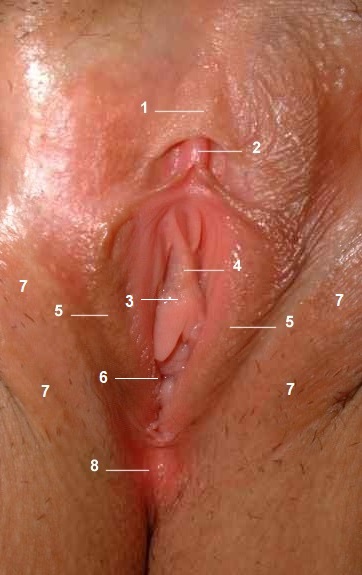
Today's anatomy lesson is going to focus on the clitoris, or clit, the main sensory organ of female sexual arousal.  As we discussed in the vulva anatomy post, the visible portion of the clit is located near the junction of the labia minora and is generally the size and shape of a greenpea  or a bit smaller than a pencil eraser.  This visible bit, called the glans, is wholly or partially covered by the clitoral hood or prepuce.  Again, I encourage you to break out your little mirror and find your clitoris and clitoral hood.

A hand roadmap to the clitoris. 1. Clitoral hood (prepuce); 2. Clitoral glans; 3. Urethral opening;
4. Vulval vestibule; 5. Labia minora; 6. Vaginal opening; 7. Labia majora (hair removed); 8. Perineum

But the clitoris doesn't stop there (contrary to what all my anatomy textbooks said!). While the glans is certainly the most readily apparent part of the clit, it has additional structures that extend through the labia majora and around the vagina opening.The clitoris is a complex structure, with both internal AND external components, and its size and sensitivity can vary greatly from person to person.    The clit as a whole is estimated to have more than 8,000 nerve endings, more than any other place in the human body (even the head of the male penis). 


The internal structures of the clitoris. Note that the clitoral hood and labia minora 
and majora are left transparent in this illustration.

The internal portion of the clitoris forms a wishbone or wing-like structure that contains the corpus cavernosum - spongey erectile tissue similar to that in the shaft of the male penis.  When aroused, these fill with blood and cause clitoral erection. That's right, we get ladyboners.

This totally would be his sex face.

The corpus cavernosum extends several centimeters before branching into a pair of crura (legs) called the crus clitoris.  These crura are concealed behind the labia minora and follow along behind it to meet at the fourchette (the lowest point of the vulva where the labia fade into the perineum or "taint").

Related to the clitoris, but actually a separate structure, are the vestibular bulbs, which are made up of the same erectile tissue.  These bulbs lie close to the crura on either side of the vaginal opening, beneath the labia majora.  When aroused, these bulbs fill with blood and cause the vulva to swell outward.

All right. Now that we know what it IS, let's talk about what it DOES.

The clit apparently exists for one reason: female orgasm.  Unlike the male penis, which is required for reproduction and urination, the clit serves no direct reproductive purpose (as female orgasm isn't required for conception) and no bodily function.  It's a pleasure center.

Just like Robert Downey Jr, it exists just to make you happy.

The majority of women (70-80%) achieve orgasm only through direct clitoral stimulation - that is, fingers or mouth stimulating the clitoral glans, hood, or shaft.  Because the glans itself is so packed with nerve endings, direct contact with it can be uncomfortable or even painful, so many women prefer indirect stimulation of the glans through the hood or labia.

For a long time, famous psychologist and all-around jerk Sigmund Freud postulated that there were 2 types of female orgasm - the clitoral and the vaginal.  He said that the clitoral orgasm was immature and adolescent and that sexually mature women would be able to orgasm through vaginal penetration alone.  His ideas persisted until Alfred Kinsey challenged them during his studies of human sexuality in the 30s, 40s, and 50s.  Kinsey observed female masturbation techniques and found that the vast majority could not orgasm vaginally, and that very few even bothered to insert fingers or objects into their vaginas while masturbating; they focused instead on the clitoris.  He eventually concluded that vaginal orgasms were nearly physiologically impossible because the vagina has so few nerve endings compared to the clitoris.

Later, Masters and Johnson built off Kinsey's research and discovered those crus clitoris which extend behind and within the labia.  They discovered that vaginal orgasms and clitoral orgasms share the exact same stages of physical response, and reasoned that the so-called vaginal orgasm was the result of indirect clitoral stimulation, such as the clitoral hood rubbing the clitoris during penetrative sex and stimulation of the internal portions of the clitoris.

A demonstration.  This is totally his sex face, too.


That seems like a good image to leave you with for this week... Next week, we move on to internal reproductive anatomy.

Friday, April 5, 2013

Anatomy: Vulva!

Today we're going to discuss external genitalia, or the vulva.  Contrary to popular vernacular, the "vagina" is not the correct term for the sum total of all your lady bits; the vagina itself is only one anatomical structure, and is internal, whereas the vulva is comprised of all the external parts of the female genitals.  If someone says they "shave their vagina," they probably mean vulva, unless they literally stick a razor inside their vaginal opening (which sounds very dangerous and unpleasant and is not recommended).

Warning: There are a lot of pictures and diagrams of female genitals in this post.  None of them are in a sexualized context, but if you're uncomfortable looking at images of ladybits, this probably isn't the post for you.

I strongly recommend finding a mirror (a makeup compact mirror works well for this) and taking a good look at your own genitals, finding all the structures that we'll be discussing in this post.  It's important to become familiar with your own body, not just to improve your comfort in your own skin but because the best way to know when something is wrong is to know what everything looks like when you're healthy. Swelling, color changes, or new bumps can indicate a medical condition that you should get checked out by your doc ASAP.

A very simple diagram of the vulva, which 
we'll be using as our roadmap.


We'll start off with the mons pubis (pubic mound, also known as the mons veneris or "mound of Venus).  This is that little mound right below the stomach and between the tops of the thighs, which even the skimpiest of thongs and bikinis will cover.  It lies directly on top of the pubic bone and is the uppermost part of the vulva. Both genders have a mons pubis, so the term mons veneris is often used to specify the female mons. The fatty tissue of the mons is very sensitive to estrogen levels, so it enlarges during puberty and will continue to fluctuate in size during a woman's menstrual cycle.


A first-person view of the mons pubis.  This woman has
chosen to shave  or wax hers of pubic hair, making the 
shape of the mound clearly visible.

During puberty, pubic hair will start to grow on the mons and labia majora. We will have a much longer and more in-depth look at pubic hair (and society's views on women's pubes specifically) in a later post, but here is a brief run-down on the short-and-curlies. Pubic hair is common to both men and women and begins to grow on the mons pubis during puberty in response to rising levels of androgens (sex hormones).  It is generally coarser, thicker, and darker in color than other body hair, though the thickness, density, and texture varies greatly from person to person. Pubic hair growth spreads as puberty continues, covering not only the mons but also the outer labia and sometimes the top of the inner thighs as well.

Naturally growing pubic hair, not trimmed or shaved.
Notice how it covers the mons, the labia, and some of the thigh.

The mons pubis divides into the labia majora (or outer lips), two fleshy folds of skin that protect the other, more delicate structures of the vulva.  The color of the outer portion of the labia majora is usually fairly close to skin color, though they often darken when you're aroused.  The insides of the folds are usually pink or brownish, but there is considerable variation.

Within the labor majora are the labia minora; while this literally translates to "smaller lips," the labia minora are often quite large and may protrude beyond the majora.

I'm gonna drop some self-esteem on you right now: your labia minora ARE NOT WEIRD.  If the only image you've ever seen of them are in porn or diagrams like the one at the top of this post, you probably thing that labia minora are supposed to be pink, small, and perfectly even.  Hell, labia minora in porn are often so small as to be almost invisible. Like the breasts, each part of the vulva is subject to a wide degree of variation from person to person in terms of size, shape, and color, and the labia minora is no exception.  Yours may be pink or brown or black; they might be long and extend past the outer labia, or short and rest fully within it; they might be thin or thick; they might be perfectly symmetrical or one may be longer, shorter, thinner, fatter, or a different color than the other. And this is TOTALLY NORMAL.  As long as they're not causing you pain or discomfort, there is nothing wrong with your labia. They're awesome.

A few variations of the female vulva.  Note the differences
in pubic hair (shaved, unshaved, and texture), coloration, the different 
shapes of the labia majora, the size variance of the labia minora.  Also, 
the centermost photo shows a clitoral hood piercing.


Okay, moving on.  Where the labia minora meet at the top of the vulva is the clitoris. Ahhh, the clitoris, so glorious, so misunderstood.  As with pubic hair, we're going to have a long look at the clitoris a bit later on, so for now we'll just stick to the portion of it that will be visible during your mirror exam (which you're totally going to do, right? RIGHT???).  The visible portion of the clitoris is called the glans, and is typically about the size of a pea, though they can vary greatly in size.  The clitoral glans is highly sensitive, and contains as many nerve endings as its male counterpart, the glans or head of the penis. The clitoral glans is usually covered by a small fold of skin call the clitoral hood, which retracts to expose the clitoris during arousal.  In women with a larger clitoral glans or a smaller clitoral hood, the clitoral glans may be partially or fully exposed at all times.  The clitoral hood is the female equivalent of the male foreskin, which also protects the sensitive glans.

A photograph of the vulva, showing (1) the clitoral glans hidden
by the clitoral hood and labia minora, and (2) the clitoral glans 
fully exposed.

The area between the labia minora is called the vulvar vestibule and contains the urethral opening and the vaginal opening.  The urethral opening is where urine from the bladder passes out of the body. Yes, this is a separate "hole" from the vagina!  You do not pee out of your vagina, and menstrual fluid does not come out of the same opening as urine.  The urethral opening is located below the clitoris, and the vaginal opening is just below that.  The term "vaginal introitus" is technically more correct than "vaginal opening," as the vagina itself is usually closed or collapsed except during arousal or insertion.  The vaginal introitus is usually partially covered by a thin, stretchy membrane called the hymen.

The hymen is a structure that is widely misunderstood, and many men and women are woefully misinformed as to its nature.  In fact, the hymen and its myths, misinformation, and social implications will be the sole topic of next week's post.

I apologize for this post going up so late (it's nearly 8pm here); it's just been a super busy day. I will do my best to have next week's post up in a more timely fashion.